
Commercial Kitchen Flooring in Menifee
Epoxy Floors Lane Menifee covers restaurant and commercial kitchen floors in Menifee — urethane cement where hot water is sprayed, epoxy in dry rooms, and a coved base at every wall — along with the Riverside County Department of Environmental Health plan check that goes with a new or remodeled food space.
Bookings aren't open yet. Leave your name and number; your message is recorded, and you'll get one message when a local installer is available.
 Illustration
The rule behind every kitchen floor
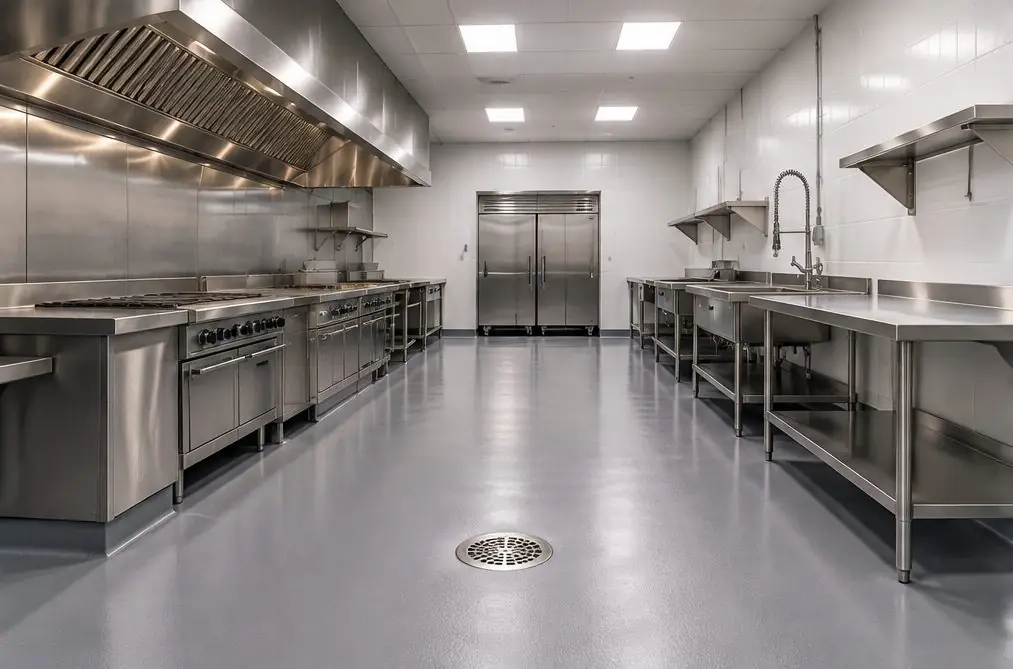
In California, floors in food facilities must be smooth, durable, nonabsorbent and easily cleanable, with a coved base where floor meets wall (California Retail Food Code, Health and Safety Code §114268). That is a description of a finished floor, not a product list: nobody approves a coating brand, so a claim that a floor is approved by a federal agency deserves a follow-up question.
The practical reading is a surface without open seams, rough pockets or crumbling edges, one that can be cleaned the way the kitchen is actually cleaned.
When epoxy is enough and when it is not
Hot-water washdowns heat the surface and then it cools. Standard epoxy can soften and let go under that cycle, so kitchens with spray-down cleaning often use urethane cement, which tolerates heat and thermal shock better. A pantry or an office that gets only a mop is a different case.
| System | Where it tends to fit | Price per sq ft (estimator) | Trade-off |
|---|---|---|---|
| Solid-color epoxy with grit | Dry storage, back hallway | $3–$7 | Not for hot-water spray |
| Decorative flake epoxy | Dining room | $6–$12 | Seams where it meets the kitchen floor |
| Quartz-filled epoxy | Prep lanes with carts | $8–$15 | Rougher texture to clean |
| Urethane cement | Cooking line, dish area, floor drains | $10–$18 | Costs more; skilled application, short working time |
A kitchen mapped zone by zone
| Zone | What hits the floor | System usually considered | Notes |
|---|---|---|---|
| Cooking line | Grease, hot spills, thermal shock | Urethane cement | Slope to the drain is a plumbing and building matter |
| Dish room | Hot water, detergent | Urethane cement | Cove at all walls and equipment bases |
| Prep area | Water, knife drops | Urethane cement or solid epoxy with grit | Grit adds grip and is harder to mop |
| Walk-in cooler | Cold, condensation | A system rated for the temperature | Ask for the data sheet |
| Dry storage | Carts, boxes | Solid-color epoxy | Often the cheapest zone |
| Dining room | Foot traffic, daylight | Decorative flake or quartz | Check the transition strip |
A coated floor can be slippery when wet or oily. Broadcast flake and a fine grit added to the top coat add texture and grip; a heavier grit adds more grip and is harder to clean.
Coved base, step by step
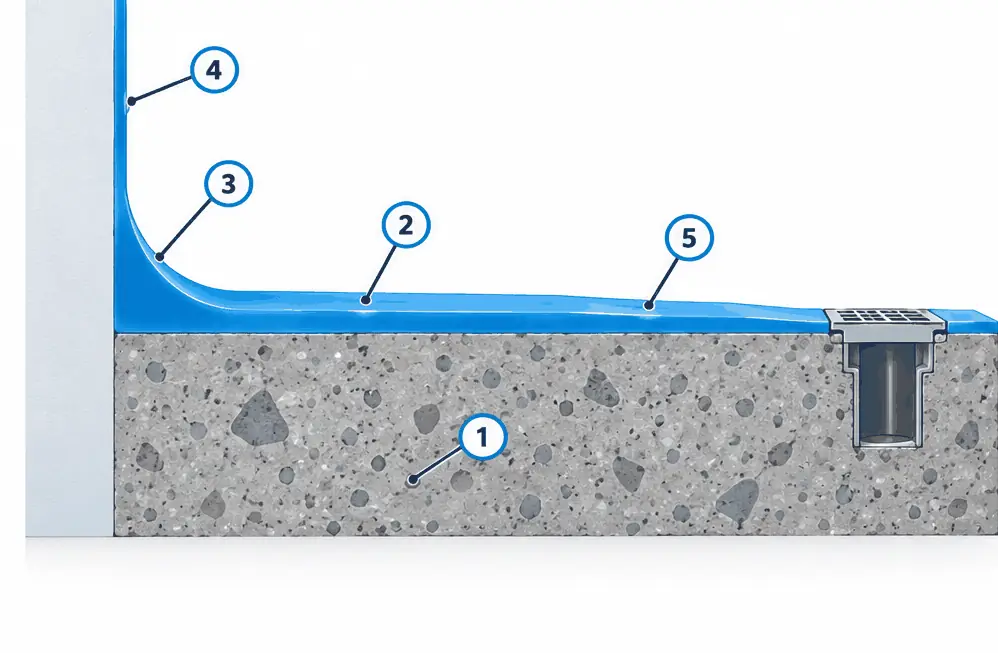
The cove is the floor curved up the wall to a set height, so water and crumbs have nowhere to collect. It is formed in the resin with a trowel and cove stick or set from a premade strip. The wall behind it needs to be smooth and sound; a cove can only seal to what it is attached to. The estimator prices a cove for up to 100 linear feet at $1,500–$2,500.
A hypothetical 1,200-square-foot kitchen in urethane cement on a sound slab costs $12,000–$21,600 at $10–$18 per square foot. Adding 100 linear feet of cove brings the total to $13,500–$24,100. Small kitchens often carry a higher per-square-foot price, and these figures are market estimates, not quotes.
What the numbers show
- Concrete slab The surface the whole system bonds to.
- Floor coating A thick, seamless layer over the slab.
- Cove A smooth quarter-round curve where floor meets wall, with no gap behind it.
- Cove base on the wall The coating carries on up the wall without a seam; the height where it stops is set in the kitchen plan.
- Slope to the drain The floor falls gently toward the drain so wash water leaves.
Riverside County plan check, in plain terms
Menifee sits in Riverside County, and the county's Department of Environmental Health reviews plans for new or remodeled food facilities and inspects them. DEH says plan approval must be obtained before a food facility is built or remodeled; the county's handout lists a plan submittal, reviewed plans that are valid for a limited time and a set number of plan copies.
The facility owner or the designer submits plans; the coating contractor delivers what is on them. A new tenant in a strip center, a restaurant remodeling its back of house and a ghost-kitchen conversion each get a plan check conversation with the county. Before choosing a finish, ask DEH what finish information its plan check requires, and read the handout for current requirements. Nothing on this page replaces that conversation.
Commercial Kitchen Flooring — common questions
Is epoxy allowed in a Riverside County restaurant kitchen?
Epoxy is used in food facilities, especially in dry rooms. The legal test is a smooth, durable, nonabsorbent, easily cleanable floor with a coved base, not a brand name. Many kitchens choose urethane cement for the hot-water zones.
Do I need county approval before changing a kitchen floor?
The Riverside County Department of Environmental Health reviews plans for new and remodeled food facilities, and its guidance says approval comes before construction. Ask DEH whether a floor change in your space falls under that review before booking any work.
Why is urethane cement so much more expensive?
It goes down thicker, takes a skilled crew and has a short working time, so the estimator lists $10–$18 per square foot against $3–$7 for solid epoxy with grit. The extra buys heat tolerance in washdown zones.
Commercial Kitchen Flooring: check availability and price range
Bookings aren't open yet — a typical Menifee range in about 30 seconds.