
Flake Epoxy Garage Floors in Menifee
Epoxy Floors Lane Menifee covers flake (chip) epoxy garage floors across Menifee — the speckled finish that hides small slab flaws — in two-car and three-car tract garages, in older Sun City and Quail Valley garages and in the larger bays of newer neighborhoods, with the work planned around Inland Empire heat.

Bookings aren't open yet. Leave your name and number; your message is recorded, and you'll get one message when a local installer is available.
 Illustration
Why flake is the usual pick for a tract garage
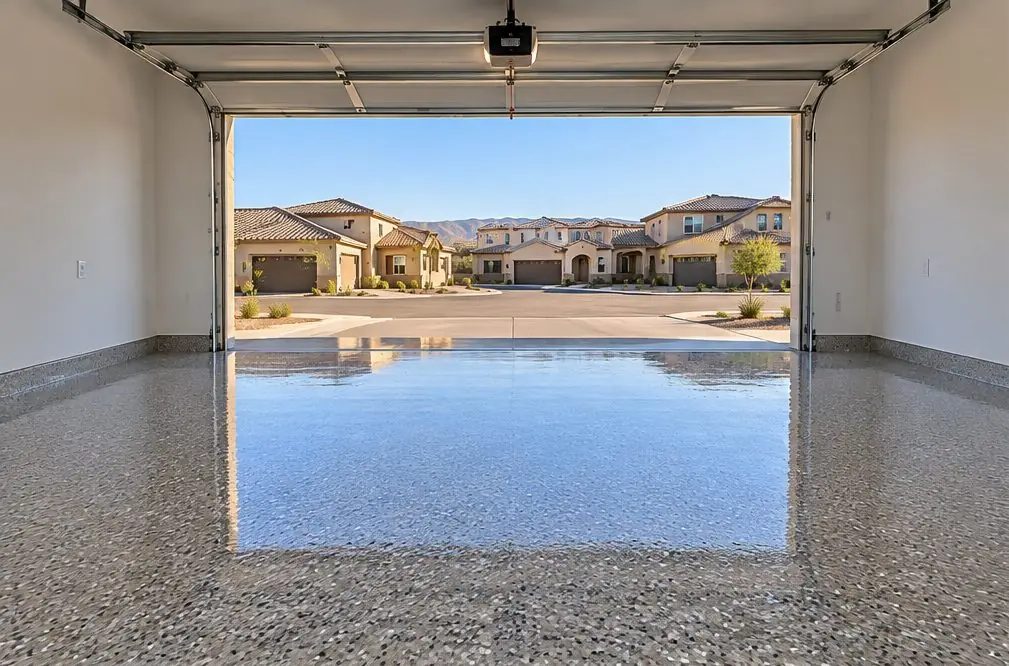
Most homes in Menifee are owner-occupied (77.4% at the 2020 census), and a great many sit on slabs poured in the last two decades. Those slabs are typically smooth-troweled, sometimes patched at the plumbing and often marked by tire dust after a few years. Flake epoxy answers three problems at once: a pigmented base, a carpet of colored chips that hides pits and patches, and a clear top coat that gives the surface a texture you can feel underfoot.
What the numbers show
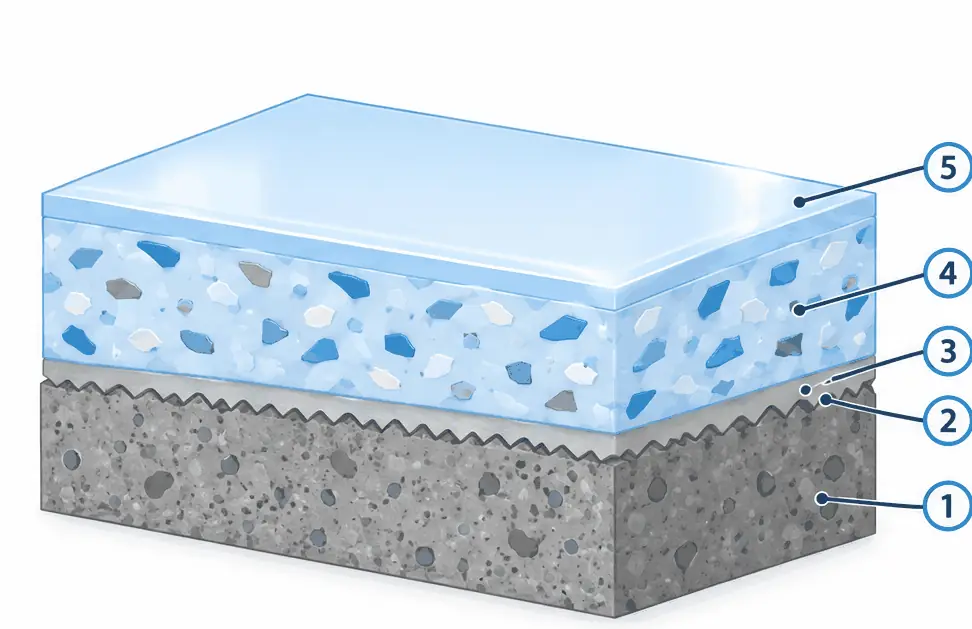
- Concrete slab The slab carries the load; a coating rides on it and adds no structure.
- Ground surface Diamond grinding leaves an open, even profile for the first coat to key into.
- Primer A thin coat that wets the opened surface so the base can bond.
- Epoxy base with flake Flakes are thrown into the wet base by hand and sit embedded, tips up.
- Clear top coat Covers the flake edges, seals the chips in and forms the wear surface.
Chip size, blend and the light in your garage
Chips come small, medium and large, in single colors or blends of three to five tones. The choice is mostly about what you want the floor to forgive.
- Small chips read as a fine speckle and sit flat under a wheel.
- Large chips make a bold pattern and show more of themselves in a big three-car bay.
- Light blends hide dust and show oil drips; dark blends hide oil and show dust.
- Mid-tone gray or tan blends sit between the two and look steady under both daylight and ceiling lights.
Ask for a sample board and look at it twice: once in the open door's daylight and once under the garage's own lamps. A screen picture of a blend rarely matches either.
A July work day, hour by hour
July highs average 97°F and August 98°F, so the slab, the air and the product all feel the heat. Installers typically build the day around the cool morning. The order below is general practice, not a schedule for a specific job.
- Early start. Prep dust is cleaned up and the slab temperature and dew point are read before anything is mixed.
- Primer and base coat. Rolled while the slab is still cool; fast-cure products have less working time as the afternoon warms.
- Broadcast. Chips go into the wet base by hand, usually before midday.
- Cure and scrape. The base sets, loose chips are scraped and swept up.
- Top coat. Applied once the slab temperature is back inside the data sheet's range, which in summer may mean late in the day.
- Shoes first, tires later. Walking and driving return at different times on the data sheet.
A quote can state the planned start time. It is a fair question, and the answer tells you how the installer handles heat.
Prices from one bay to five
Typical Menifee ranges for full-broadcast flake on a sound slab, from the estimator ($5–$8 per square foot). The table runs past three cars for the larger garages:
| Garage size | Area | Typical total |
|---|---|---|
| 1-car | 240 sq ft | $1,200–$1,920 |
| 2-car | 400 sq ft | $2,000–$3,200 |
| 3-car | 700 sq ft | $3,500–$5,600 |
| 4-car | 900 sq ft | $4,500–$7,200 |
| 5-car or larger | 1,200 sq ft | $6,000–$9,600 |
A price guide for Menifee lists $6–$9 per square foot for epoxy in general, which falls inside this range. Slab condition moves the price per square foot: minor cracks or pitting add $1–$2, an old coating to take off adds $1–$3, and a damp or oil-soaked slab adds $2–$4. The stem wall and the entry steps are flat extras. These are market estimates, not quotes.
Before the chips: new slabs and the association
A garage in a newer tract may have a curing compound or a clear builder's sealer on the surface. Both are ground off before coating, and both are a reason a floor coated too soon can peel. Manufacturers advise a slab be at least 28 days old, and in some conditions up to 60. A moisture test, ideally in-slab humidity probes, decides more than the calendar does.
Many Menifee neighborhoods have a homeowners association. The inside of a garage is usually not what CC&Rs cover, but contractor parking, work hours and how long the door stays open sometimes are. The association decides, so a short note to the management company before the work saves a surprise.
Lines worth comparing on two flake quotes
| Line | What to ask |
|---|---|
| Prep | Diamond grinding, not etching alone, and the texture it aims for |
| Coverage | Full or partial broadcast, written on its own line |
| Film | The base and top coat named, with thickness in mils |
| Moisture | Which test, what reading, and what happens if it reads high |
| Timing | Start time on a hot day and the date a car may return |
Two quotes that differ by a dollar a square foot may differ in exactly one of these lines.
Flake Epoxy Garage Floors — common questions
How long does flake epoxy take to cure on a hot Menifee day?
It depends on the product, the slab temperature and the humidity, and the data sheet names the times. Heat shortens the working time, so installers tend to start early; foot traffic usually returns before vehicles do.
Is flake epoxy a good fit for a three-car garage?
Yes, and it is a common choice, because a large bay shows more of the slab and the chips hide small flaws. A 700-square-foot three-car floor runs about $3,500–$5,600 on a sound slab, from the estimator.
Flake Epoxy Garage Floors: check availability and price range
Bookings aren't open yet — a typical Menifee range in about 30 seconds.