
Garage Floor Prep, Grinding and Crack Repair in Menifee
Epoxy Floors Lane Menifee covers concrete prep for Menifee garage floors — diamond grinding, crack and spall repair and moisture testing — on both the new slabs of recent tracts and the older slabs of Sun City and Quail Valley, which together decide whether a coating stays down and which most quotes bury in a single line.

Bookings aren't open yet. Leave your name and number; your message is recorded, and you'll get one message when a local installer is available.
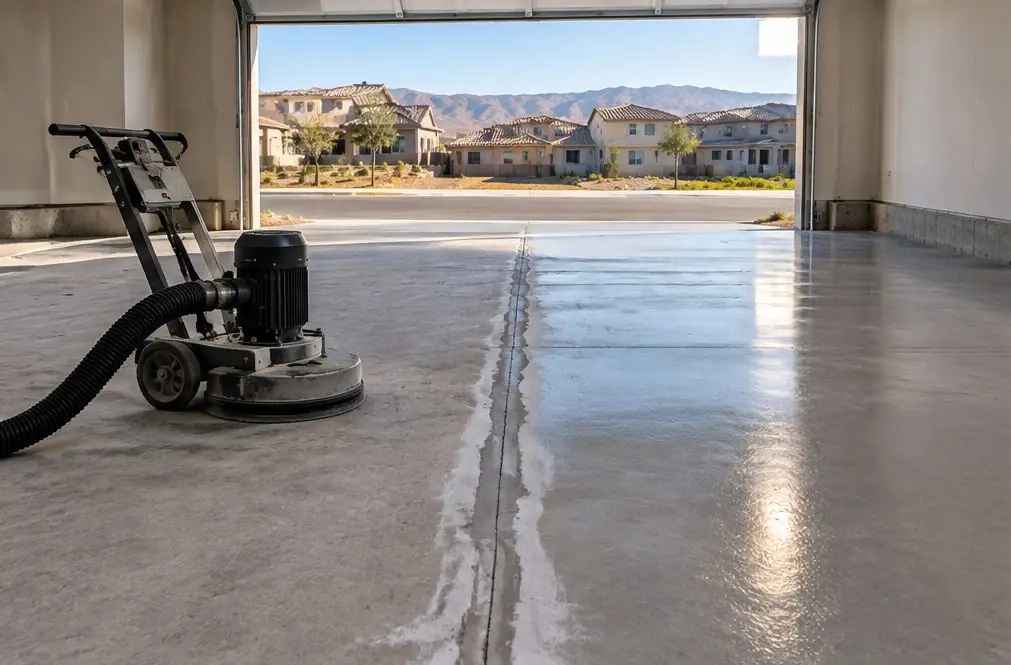 Illustration
What each kind of slab arrives with
| Recent tract slab | Older Sun City or Quail Valley slab | |
|---|---|---|
| Surface | Smooth-troweled, often burnished | Worn, possibly oil-stained and patched |
| On top | Builder's curing compound or clear sealer | Old paint, a failed coating or stains |
| Cracks | Shrinkage cracks and sawed control joints | Settlement cracks and old repairs |
| Moisture | Still drying; age and a test matter | Usually dry, but a patch may hide a damp spot |
| First task | Remove the compound, then test | Remove the old finish, then repair |
Sun City's grading began in December 1961, so some slabs there have decades behind them. Neither type is better; each asks for a different first hour.
Why grinding beats etching
- Etching uses acid to dissolve the cement paste. It gives a light, uneven profile, does not remove a curing compound or an old coating, and leaves rinse water to manage.
- Diamond grinding cuts the surface open with diamond tooling, removes compounds and thin coatings and leaves a profile an installer can match to the data sheet. Dust goes to a shroud and a vacuum.
Acid etching is a weaker substitute. A quote that says only "etch" is worth a question, and a quote that says "grind" should name the profile it aims for.
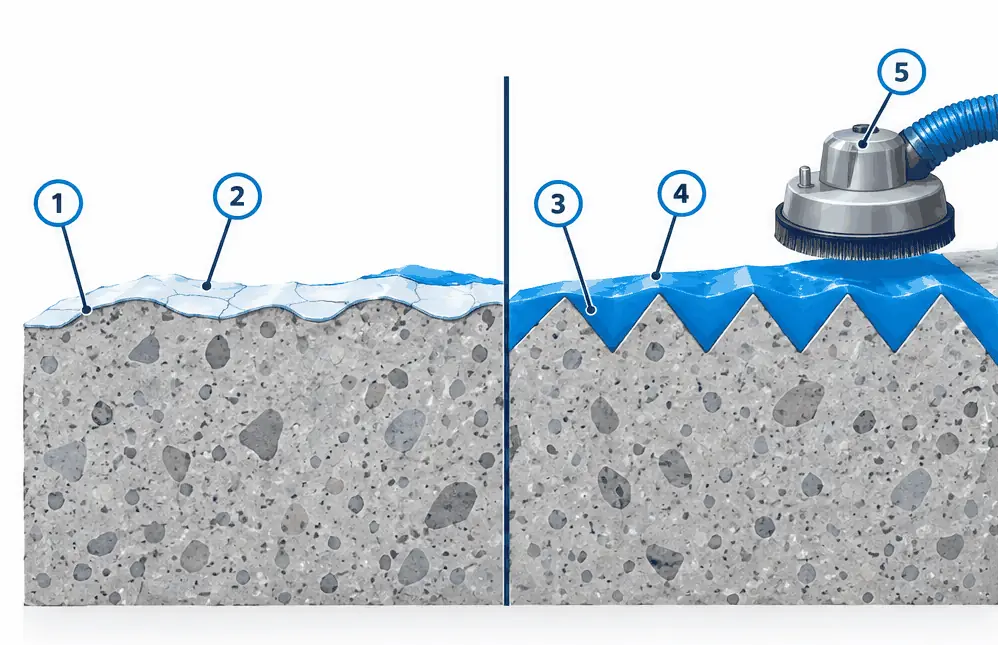
What the numbers show
- Etched surface Acid leaves a shallow, uneven texture.
- Loose film Laitance and old sealer can stay on the etched surface and let go with the coating.
- Ground surface A grinder cuts an even profile of peaks and valleys.
- Coating in the profile The first coat fills the valleys and grips the peaks.
- Shroud and hose A dust shroud and vacuum hose keep the grinding dust out of the air.
Reading a new slab's moisture
Manufacturers advise a new slab be at least 28 days old, and in some conditions up to 60. Curing and drying are different things, so an old enough slab can still be too wet. Three tests are in common use:
| Test | Method | Reading it gives |
|---|---|---|
| Plastic sheet | A sheet is taped down for a day or so | A quick first look; condensation means vapor |
| Calcium chloride (ASTM F1869) | A sealed dish absorbs vapor over about three days | The rate at which vapor leaves the surface |
| In-slab relative humidity (ASTM F2170) | Probes sit in drilled holes | The reading described as the most accurate |
The system being installed sets the limit it tolerates. If a reading is high, a moisture-mitigating primer goes down or the job waits.
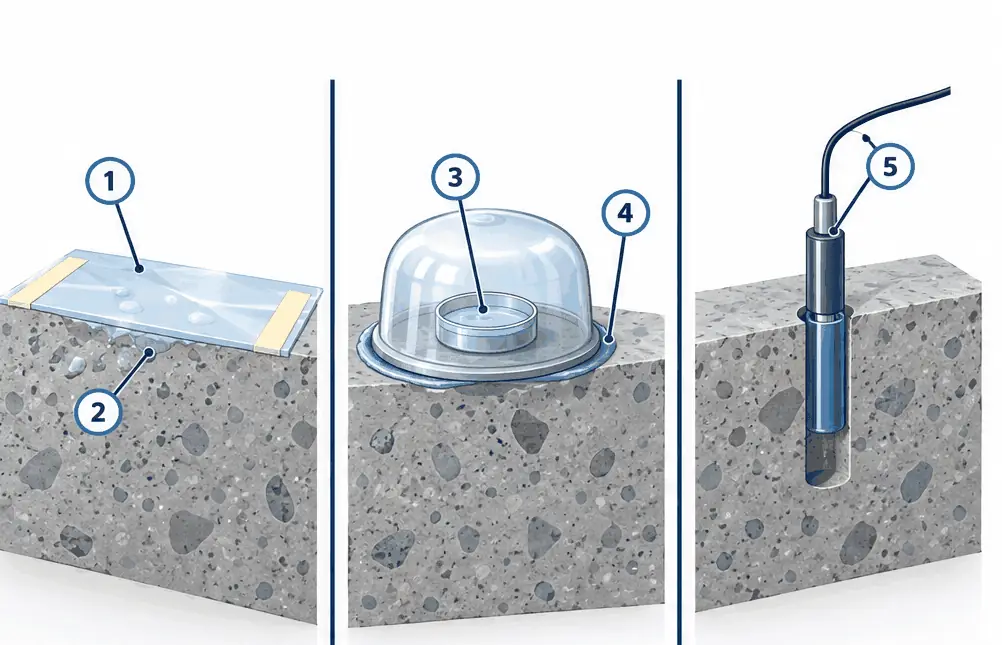
What the numbers show
- Plastic sheet A square of plastic taped down on every edge and left for a day or more.
- Droplets Moisture under the sheet or a dark patch on the slab means vapor is rising; a first look, not a reading.
- Calcium chloride dish A weighed dish of salt under a sealed dome; the weight gain measures vapor leaving the slab.
- Sealed dome rim The rim is sealed so only the slab's own vapor reaches the dish.
- In-slab probe A probe in a sleeve inside a drilled hole reads the humidity inside the concrete.
Cracks, joints and spalls
| Defect | Typical repair | What to expect |
|---|---|---|
| Hairline shrinkage crack | Routed, filled and ground flush | Often stays closed |
| Sawed control joint | Cleaned and filled with a flexible joint filler | Moves with the slab |
| Chip or pit | Repair mortar, ground smooth | Invisible under flake, visible under solid color |
| Stepped or growing crack | Filled, and the movement watched | May show again through the coating |
A moving crack can show again. A repair is a reasonable fix, not a promise the crack stays shut.
What prep adds, in dollars
Prep on a sound slab is part of the base price. Cracks, pitting and small spalls add $1–$2 per square foot. A damp or heavily oiled slab adds $2–$4. Totals below are for flake epoxy ($5–$8 per square foot on a sound slab):
| Garage | Surcharge, cracks and pitting | Flake total with cracks ($6–$10) |
|---|---|---|
| 1-car, 240 sq ft | $240–$480 | $1,440–$2,400 |
| 2-car, 400 sq ft | $400–$800 | $2,400–$4,000 |
| 3-car, 700 sq ft | $700–$1,400 | $4,200–$7,000 |
With a damp or oily slab ($7–$12 per square foot), a 400-square-foot garage comes to $2,800–$4,800. Market estimates, not quotes.
Prep on a hot, dusty day
Grinding raises dust, so the shroud and vacuum run and the door stays open. In summer the work is often done in the morning, and the slab is cleaned and checked before the coating day. Prep is a distinct step from coating, and some installers split them over two days; a quote can state whether the prep and coat happen on the same visit.
Garage Floor Prep and Crack Repair — common questions
How do I know if my new garage slab is ready for a coating?
Age is a start (manufacturers advise at least 28 days), and a moisture test is the decider. In-slab humidity probes are described as the most accurate, and the data sheet of the chosen system names the limit.
Does a builder's curing compound have to come off?
Typically yes. A curing compound or sealer on the surface can stop a coating from bonding, so it is ground off before priming.
Garage Floor Prep and Crack Repair: check availability and price range
Bookings aren't open yet — a typical Menifee range in about 30 seconds.