
Polyaspartic Garage Floor Coating in Menifee
Epoxy Floors Lane Menifee covers polyaspartic and polyurea garage floor coatings in Menifee — the quick-curing systems often sold as one-day floors — for garages with a door that faces the afternoon sun, with heat, pot life, new-slab moisture and the cure stages explained before the price.

Bookings aren't open yet. Leave your name and number; your message is recorded, and you'll get one message when a local installer is available.
 Illustration
Two layouts that carry the same name
Polyaspartic is one kind of polyurea, formulated to give the installer a little more working time than a straight polyurea. In a quote the word can mean two different builds:
| Layout | What goes down | Typical use |
|---|---|---|
| Hybrid | Epoxy primer and base carry the chips; a thin polyaspartic top coat seals them | The layout the estimator prices at $6–$10 per sq ft |
| Polyaspartic throughout | Polyaspartic primer, base and top coat | The fastest cure, the least working time and the most demanding of the slab |
Ask which one the quote means. A hybrid and a full polyaspartic job are different products at different prices.
What the numbers show
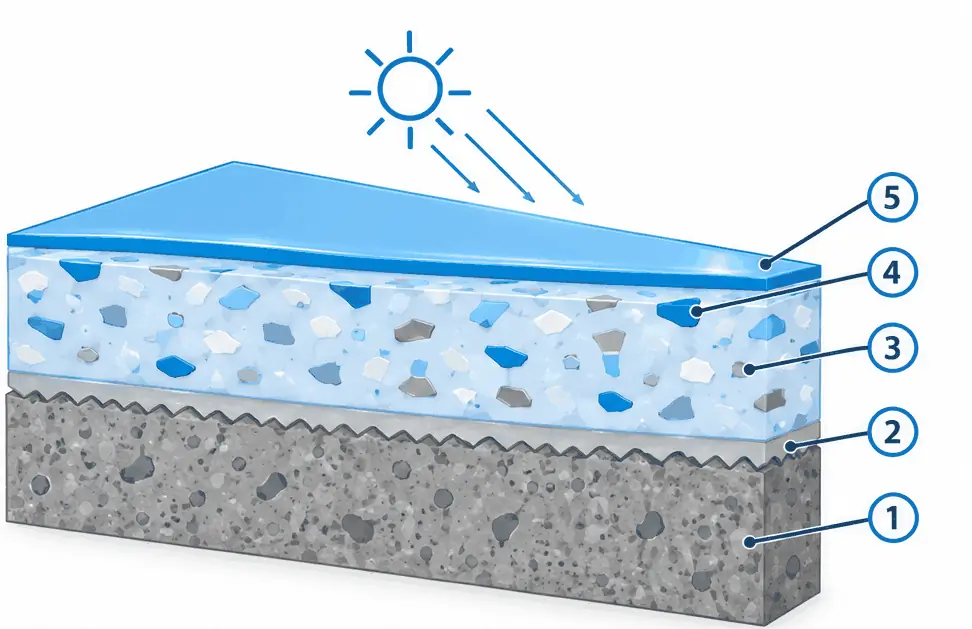
- Concrete slab Ground and moisture-checked before any product goes on.
- Ground surface The profile the epoxy layer grips.
- Epoxy primer and base Bonds well to a ground slab and leaves time to place the flake.
- Flake Embedded in the base, not floating on the surface.
- Polyaspartic top coat A thin, fast-curing layer that is generally more UV-stable than epoxy.
Pot life when the afternoon hits 97°F
Polyaspartic sets quickly, and heat shortens the working time further. July highs in Menifee average 97°F, with a record of 117°F, so a pour that would be comfortable on a mild morning can become a race by noon. The installer typically mixes small batches, rolls fast and broadcasts straight away, and the start is pushed to the cool hours.
This is where the installer's habits show. A crew that mixes a large batch on a hot slab risks lap marks, bubbles and a rushed broadcast. Ask when the work starts, how the slab temperature is read and how much is mixed at a time.
What the cure stages usually look like
Plenty of polyaspartic systems go down in a single day. That describes the install, not the finish line. The pattern below is typical; the product's data sheet gives the real times for the temperature and humidity of the day.
- Day of install. Primer, base, chips and top coat go down, often within one long day for a two-car garage.
- The next day. Foot traffic usually returns, in clean soft-soled shoes.
- Within the first days. Light items and shelving return after the data sheet's light-use time.
- Vehicles. A car comes back after the time on the data sheet, often 24 hours to several days depending on the product, temperature and humidity.
- First weeks. Cleaners, oils and brake fluid wait for the full chemical cure the sheet lists.
Get the date a car may return in writing, and keep vehicles in the driveway until then.
A new slab and a fast coating
Quick-curing coatings leave little time for moisture to escape. A tract-home slab that is 28 days old can still be giving off vapor, and manufacturers advise waiting at least 28 days and up to 60 in some conditions. In-slab relative-humidity probes are described as the most accurate reading, and the system being installed sets the limit it tolerates.
A polyaspartic top coat on a damp slab can blister or cloud as the vapor looks for a way out. If readings are high, a moisture-mitigating primer is used or the job waits. That is a reason to ask for the test result in the quote, not a reason to skip polyaspartic.
Sun at the open door, tires on the pad
Epoxy can amber in sunlight, which shows where a garage door faces west and stays open on summer afternoons. Polyaspartic top coats are generally more UV-stable, and that is the usual reason for choosing one in Menifee. Hot-tire pickup, where a warm tire lifts the coating, is mostly a prep and product problem; a ground slab and a system rated for it reduce the risk.
Certain systems smell strongly during the cure. The door stays open, people and pets keep out until the data sheet says otherwise, and a garage that shares a wall with a bedroom needs a plan for airing. Coatings sold and applied in California must meet the local air district's VOC limits for floor coatings, so the products differ from some sold elsewhere.
What polyaspartic flake costs by size
Typical Menifee ranges for a polyaspartic flake floor on a sound slab, from the estimator ($6–$10 per square foot):
| Garage size | Area | Typical total |
|---|---|---|
| 1-car | 240 sq ft | $1,440–$2,400 |
| 2-car | 400 sq ft | $2,400–$4,000 |
| 3-car | 700 sq ft | $4,200–$7,000 |
Against full-broadcast epoxy flake that is $1–$2 more per square foot, about $400–$800 on a two-car garage. Cracks, an old coating or a damp slab add to either system. Market estimates, not quotes.
Polyaspartic Garage Floors — common questions
Is polyaspartic worth the extra cost in Menifee's heat?
Its more UV-stable top coat helps where the door faces the afternoon sun. The trade-off is a very short working time on a hot day, so the quality of the crew and the start time matter as much as the product.
Can a polyaspartic floor be coated on a newly built slab?
Only after the slab has aged, often at least 28 days, and tested dry enough for the chosen system. A moisture test result decides, and a high reading means a primer or more waiting.
Polyaspartic Garage Floors: check availability and price range
Bookings aren't open yet — a typical Menifee range in about 30 seconds.