
Auto Shop Floor Coating in Menifee
Epoxy Floors Lane Menifee covers floor coatings for auto repair shops, tire shops and workshops in Menifee — service bays, lift pads, wash corners and counters — planned around fluids, hot tires, point loads and a roll-up door that faces the afternoon sun.
Bookings aren't open yet. Leave your name and number; your message is recorded, and you'll get one message when a local installer is available.
 Illustration
The worst spill sets the system
Motor oil, coolant, brake fluid and cleaning solvents all end up on a shop floor, and bare concrete soaks them up. A coating seals the surface so spills are wiped instead of absorbed. The system is chosen for the harshest thing that touches each zone.
| Zone | Main stress | System usually considered | Estimator range per sq ft |
|---|---|---|---|
| Bay between lifts | Oil, tires, creeper wheels | Solid-color epoxy with grit | $3–$7 |
| Under lift baseplates | Point loads from steel feet | Quartz-filled broadcast on a sound slab | $8–$15 |
| Tire and wheel area | Hot rubber, abrasion | Quartz or a UV-stable top coat | $8–$15 |
| Wash corner | Water, detergent, runoff | Urethane cement or sealed epoxy | $10–$18 |
| Counter and waiting area | Foot traffic | Decorative flake | $6–$12 |
Lifts, anchors and the slab underneath
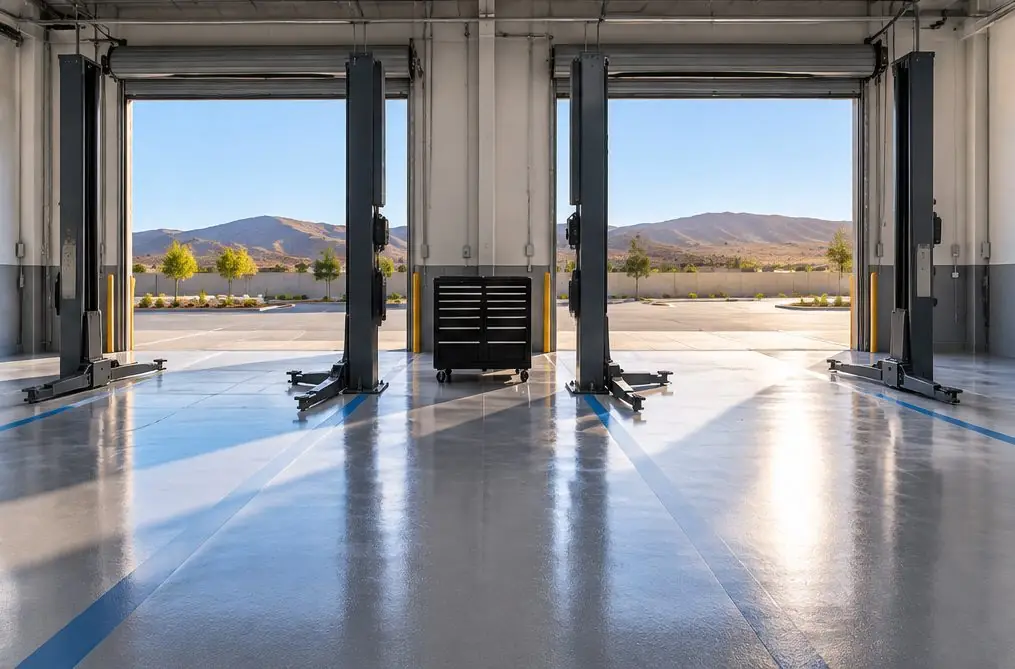
Lift posts are bolted into the concrete. A coating does not strengthen a slab, so a cracked or thin slab under a lift is assessed before anything is rolled on. A contractor who finds a crack running through an anchor pattern should say so in writing and leave the decision about the lift to the people who manage it.
Fluids, tires and grit
Chemical resistance is read from the data sheet of a named product against the actual fluids, concentrations and exposure times; no coating resists everything, and brake fluid is hard on many resin systems. Hot-tire pickup, where a warm tire lifts the coating, is mostly a prep and product problem, and a ground slab and a system suited to it reduce the risk.
A coated floor can be slippery when wet or oily. Broadcast flake and a fine grit added to the top coat add texture and grip; a heavier grit adds more grip and is harder to clean, so the shop picks a point between the two.
Heat, roll-up doors and a shop that stays open
Bay doors stand open in Menifee summers, when mean July highs are 97°F. A slab warmed by the sun shortens the working time of a fast-cure product, so coating is scheduled for the cool morning and the bay nearest the door is often done first thing or last. A shop with two bays can coat one while the other works, then swap, with each bay returning to foot traffic and rolling tools per the data sheet.
A two-bay shop as a sample
A hypothetical 900-square-foot two-bay shop with oil-soaked concrete: solid epoxy with grit at $3–$7 per square foot plus the oil and moisture surcharge of $2–$5 gives a working rate of $5–$12, so the total is $4,500–$10,800. If old paint must come off first, the old-coating surcharge of $2–$4 is added to the estimate instead of or beside it.
| Item (hypothetical) | Rate per sq ft | Area | Total |
|---|---|---|---|
| Solid epoxy with grit, oil-soaked slab | $5–$12 | 900 sq ft | $4,500–$10,800 |
Market estimates, not quotes; a contractor measures the slab and tests it first.
Auto Shop Floor Coating — common questions
Will oil and brake fluid damage a coated shop floor?
Brake fluid and some solvents are hard on many resin coatings. The product's chemical-resistance chart lists what it handles, and spills are wiped quickly instead of left to soak.
Can a coating go under a vehicle lift?
Often, on a slab that is sound and tested. The coating does not strengthen concrete, so cracks near lift anchors are assessed first.
Auto Shop Floor Coating: check availability and price range
Bookings aren't open yet — a typical Menifee range in about 30 seconds.