
Epoxy, Polyaspartic or Polyurea: What Suits a Garage in Menifee?
Epoxy Floors Lane Menifee lines up epoxy, polyaspartic, polyurea and hybrid garage coatings, explains how the product names overlap, and weighs them against what Menifee garages actually face: summer highs near 97°F, west-facing doors and slabs from new tracts.
Bookings aren't open yet. Leave your name and number; your message is recorded, and you'll get one message when a local installer is available.
The floor as it starts
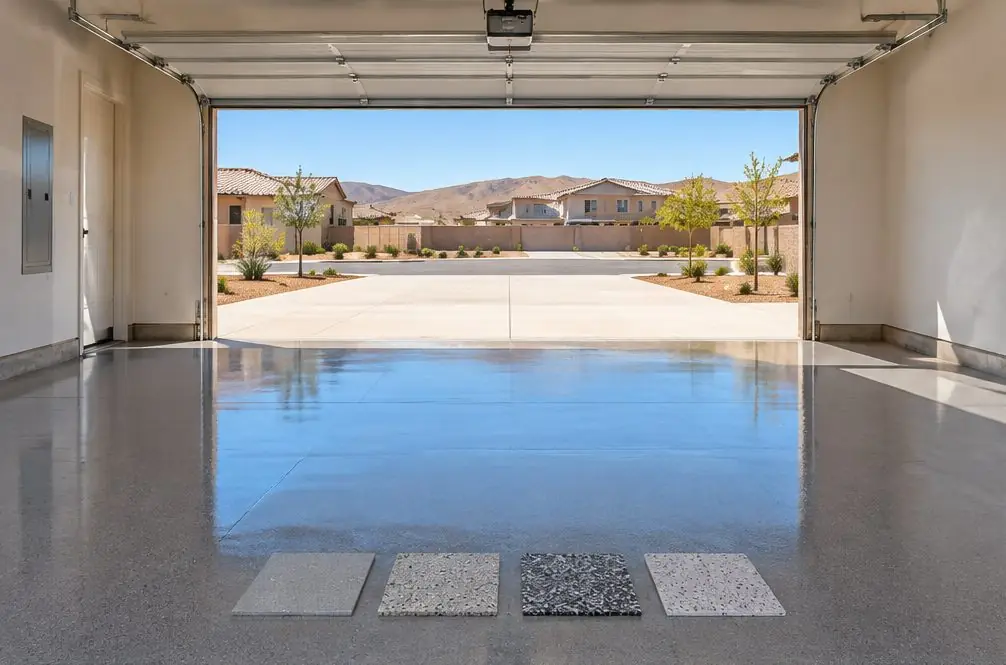 Illustration
The finished floor (illustration)
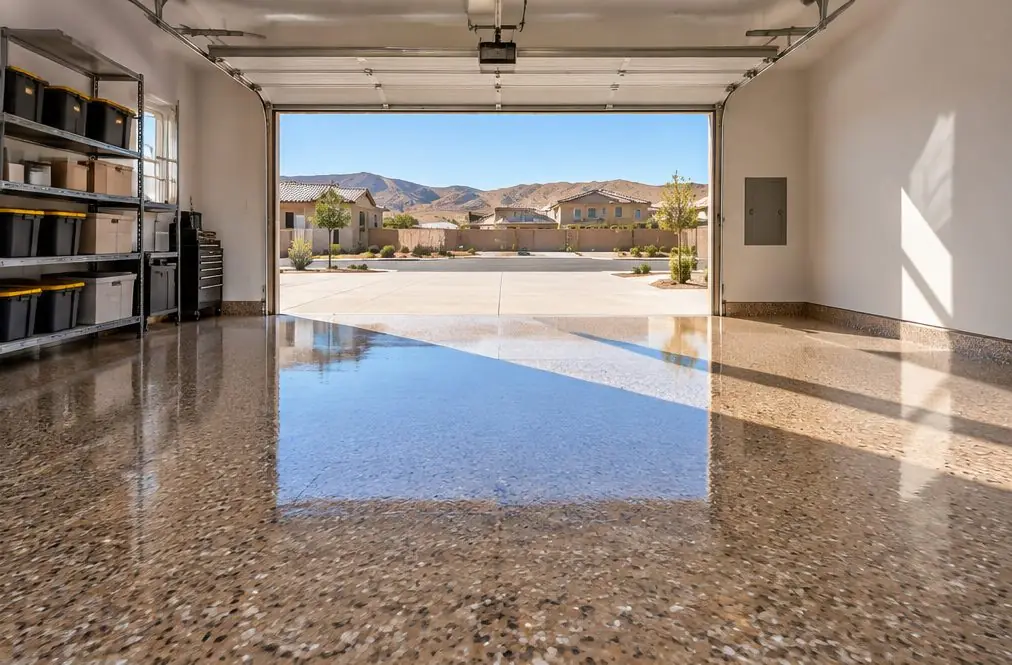 Illustration
How the product names overlap
Most of the confusion comes from vocabulary, so it is worth sorting out before comparing anything. Epoxy is a two-part resin: a base and a hardener are mixed on site and cure into a rigid film. Polyurea is a separate resin family that reacts quickly. Polyaspartic is a member of that family, tuned to react a little more slowly so an installer gets some minutes of working time. A page that sets "polyaspartic" against "polyurea" is usually describing neighbors, not strangers.
The fourth option, the hybrid, is the one many Menifee garages end up with: an epoxy primer and base coat that grip the ground slab, color flake thrown into it, and a polyaspartic or polyurethane clear on top. In that stack the base does the gripping and the top coat does the sun and scuff work.
What a hot inland summer changes
Menifee's mean high is about 97°F in July and 98°F in August, and the record is far above that. Heat touches a coating job in two ways.
- Working time. Fast-cure products have less working time on a hot afternoon. The same polyaspartic that gives a crew some relaxed minutes in spring can leave far fewer when the slab is warm, which is why installers lean on early starts and small mixed batches.
- Outgassing. A slab that warms through the day can push air out of its pores into a fresh coat, leaving pinholes or bubbles. Starting while the slab is cooling or still cool helps.
Sun is the other half. Epoxy can amber (yellow) in sunlight, which shows most where an open door lets a strip of sun fall across the floor every afternoon. Polyaspartic and aliphatic polyurethane top coats are generally more UV-stable. For a garage that faces west and stays open while someone works inside, the top coat deserves more thought than the flake color.
The systems side by side
The table describes general tendencies. A specific product's data sheet can sit outside them.
| Epoxy base and top coat | Hybrid: epoxy base, polyaspartic top | Full polyaspartic or polyurea | |
|---|---|---|---|
| Open door and afternoon sun | Can amber over time | Top coat takes the sun | Generally UV-stable |
| Working time on a hot day | Longest of the three | Base is relaxed, top coat is short | Shortest |
| Typical install pace | Often several days before a car | Often a day or two | Many systems finish in one day |
| Odor while curing | Noticeable | Strong during the top coat | Strong in the first days |
| Reaction to a damp slab | Vapor can lift it | Same risk under the epoxy base | Can bubble or pinhole |
| Where it usually fails | Poor grind, damp or oily slab | Bond between the two layers | Rushed mixing, warm slab |
Warm, ventilated garages smell strongest during the top-coat stage; people and pets stay out until the data sheet says otherwise.
Price bands from the Menifee estimator
The estimator on this site prices each system per square foot, installed, on a sound slab. A two-car garage is about 400 square feet, so the totals below are the range times 400.
| System | Range per sq ft | About 400 sq ft |
|---|---|---|
| Solid-color epoxy | $3–$6 | $1,200–$2,400 |
| Full-broadcast flake epoxy | $5–$8 | $2,000–$3,200 |
| Polyaspartic flake (epoxy base, polyaspartic top) | $6–$10 | $2,400–$4,000 |
| Metallic epoxy | $8–$12 | $3,200–$4,800 |
Polyurea and full polyaspartic systems are not priced as separate lines in the estimator; the polyaspartic flake line is the closest. A home-services price guide for Menifee lists $6–$9 per square foot for epoxy floors in general, which sits inside the flake and polyaspartic bands above. All of these are market estimates, not quotes.
Matching a system to the garage
A few plain questions usually settle it:
- Does the door stay open? Often means a UV-stable top coat is worth pricing.
- Is it a rarely opened storage garage? Solid color or flake epoxy keeps the cost down.
- Is the slab only a few months old? The coating question comes second to the moisture question; see the guide on testing the slab.
- Does the household need the car back quickly? Ask each installer for the return-to-service times from the data sheet, for foot traffic and for tires, at the temperature expected that week.
- Is there a homeowners association? The association decides what applies to contractor parking and working hours; a short note to the management company avoids surprises.
The choice is rarely epoxy against polyaspartic as a contest. It is a question of how many layers the garage needs and which one faces the sun.
Where this leads
- Service page: Polyaspartic Garage Floors — A fast-curing, more UV-stable top coat over an epoxy base, with what heat and a new slab do to it laid out before the price.
- All services and typical prices: epoxy garage floors in Menifee
- More illustrated guides: Epoxy Floor Guides
Check availability and the price range for this setup
Bookings aren't open yet — a typical Menifee range in about 30 seconds.